Squint and You Can See Trans Archie
Look closely at a comic I grew up with and you can see how we got lost as a culture in America. That’s the long-term effect of moral panic
As ever and for ever, Gender Defiant is paywall-free. Please share this essay with friends and consider a paid subscription to help us cover expenses!
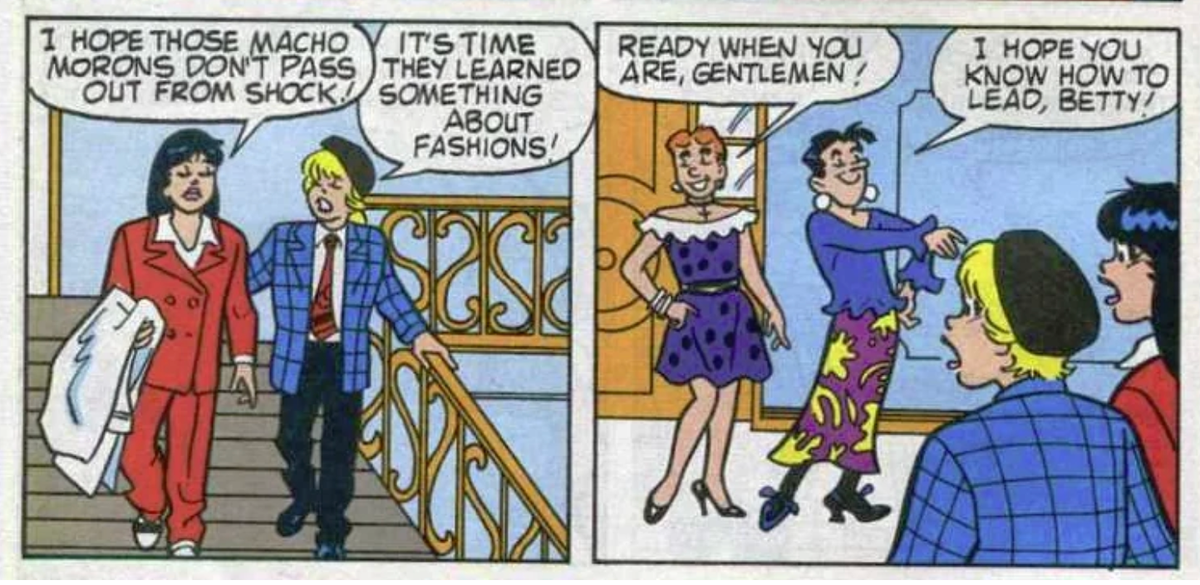
Once upon a time in the mid-20th century, Betty and Veronica, the teengirls of Archie Comics, were escapade-having, cross-dressing BFFs. What?
I was shocked to learn this last week (on a wonderful episode of the podcast Articles of Interest). Whereas the Betty and Veronica I grew up with existed just to be boy-crazy, old school Betty and Veronica did all kinds of weird shit. They were bad at cooking; they played sports—this was the 1940s and ’50s, decades before Title IX mandated sports for girls. Oh and Archie and Jughead, their guy friends, sometimes wore dresses.
That all ended with the Comics Code. It hit in 1954, when Seduction of the Innocents, a book of pseudoscience, was popular with certain politicians. (Sounds familiar.) The author called comics “dangerous literature” responsible for juvenile delinquency. Conservatives glommed on.
Enter the Comics Code, which “fixed” Archie by erasing all hints of future queerness, eliminating every shadow of a dark side, and robbing Betty and Veronica of their imagination and their fun-seeking selves.
Learning about all this makes me see, starkly, the effects of that long-ago moral panic on a parent of a trans teen now (me). And makes me wonder about the lasting effects of the current Trans Panic.
Faint smoldering
The comics code happened in the ’50s, the same time we had the Hays Code punishing “sex perversion” in movies, the Lavender Scare unleashing state violence on gays and lesbians, and Red Scare McCarthyism persecuting liberal ideologies, artists, citizens. I wasn’t alive in the ’50s, but decades later, its effects were alive on a regular day in my American life, grocery shopping with my mom.
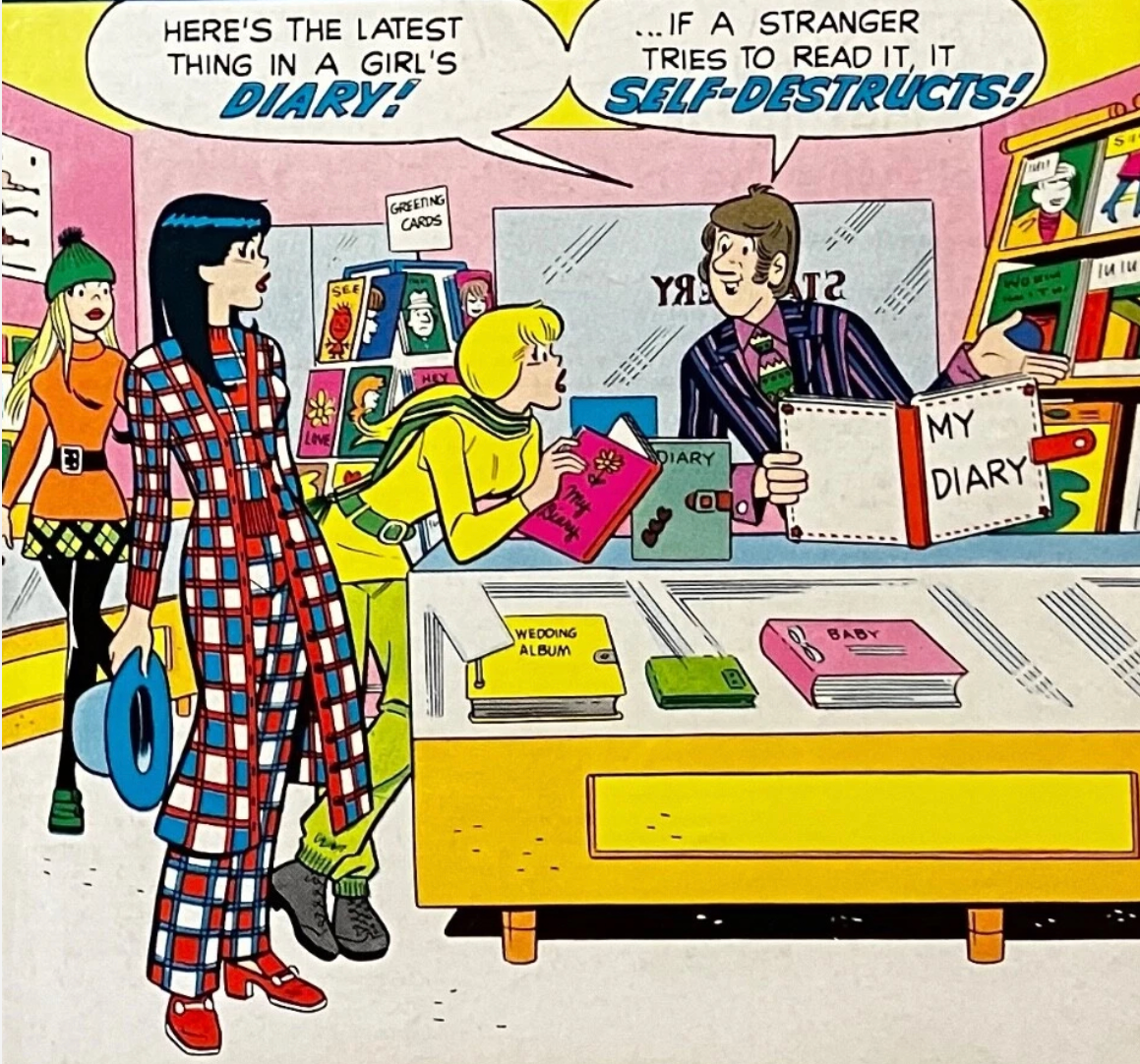
In the Archie comic I bought, Betty and Veronica did not win a dance contest by cross dressing and partnering with each other. They did not run for class president. They were the hetero-marriageable girls the Code made them be, obsessed with boys and clothes. (To be fair, Betty and Veronica’s clothes were fantastic, and I loved them.)
Surmountable cringe
When I learned Betty and Veronica once had a full life doing interesting things, and that the Archieverse had been on what looked like a steady path to queerness, it was easy to envision how my life, right now, as a person and parent, would be different—healthier, easier—had there been no moral panics, no Comics Code.
It’s not hard to picture. If the Archie Gang’s lives had rolled out uninterrupted from the ’40s, cross dressing, or wearing whatever clothes, would not have been worth having an opinion about particularly. Anyone could be class president. Characters would have been gay and lesbian after a painful but surmountable period of cringe gags quickly seen as dated. Queer and trans kids in Archie's fictional town of Riverdale would periodically emerge, play a leading or minor role, and move along, as characters in comic books do.
Popular culture is no small thing. If we were used to seeing trans lives reflected in it, the parents of trans kids I know—and the trans kids I know—would not question themselves or struggle so much. The country wouldn’t be in a Trans Panic, with ordinary lives criminalized, rising suicide rates among our kids, moral entrepreneurs hawking lies that Washington deploys to terrorize people.
I’m not saying the Trans Panic is because of the Comics Code—but that it sprang out of the residue of the panic, because that’s how moral panic works.
Decades after the fear-mongering about lesbians, immigrants, hippies, or rap music, fades, a residue of fear sticks around. Even more than firehoses or street executions, that’s what politicians want. A faint, lingering hate that keeps us divided and keeps them in power.
Snuck over the line
Today, Archie has a trans character, Danni Molloy. Danni Molloy has in fact been around Archie Comics as a character since the 1990s, but in 2023, comic artist Magdalene Visaggio, a trans woman herself, “transed” (Visaggio’s word) her.
“I’d like to apologize for sneaking her over the line like this!” Visaggio said. “I never wanted Danni’s trans identity to be gimmicky, or for her to feel like she was only created to be trans.
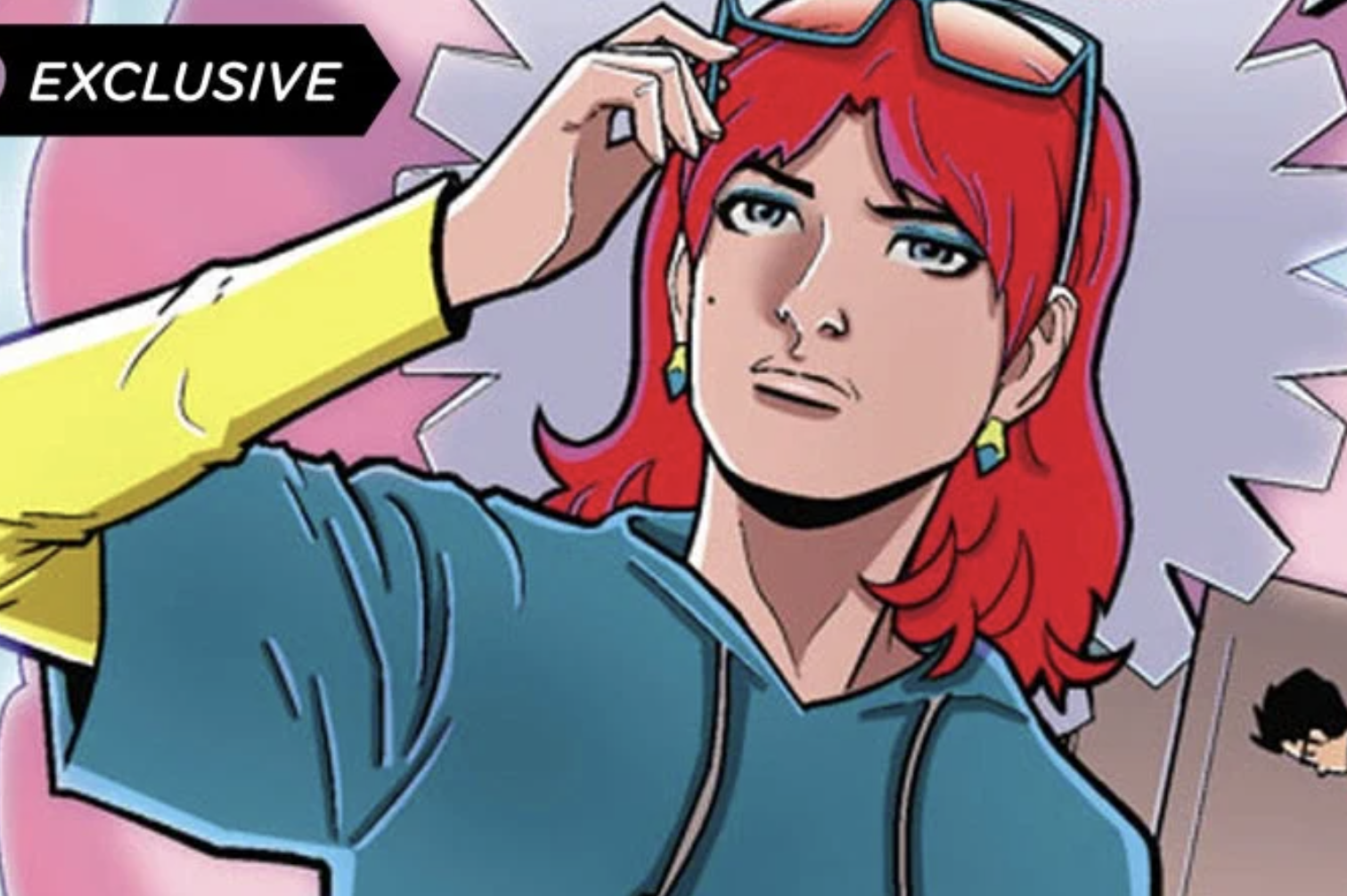
“I wanted you to have a chance to fall in love with Danni for who she is, not what she is....I’m grateful to Archie for never, not even once, pushing back on my insistence on making their books a little bit more queer,” Visaggio added.
Or: queer again.
Archie has been working for years to be more progressive and wide in representation. There was an Occupy Wall Street story. There is a live action Archies Bollywood adaptation. There are gay characters. And Jughead was revealed as asexual in 2016: “It’s just stated, not as a joke, not with anyone questioning Jughead, it was just a fact. Something that everyone seemed to know and acknowledge about Jughead. Which was really great to read,” said Desiree Rodriguez of WWAC (Women Write About Comics).
The unstudied, understated acceptance of Jughead is what I would have hoped for in comics, and of trans kids, teens, families, and adults in real life. Because things move more quickly now than in the ’50s or ’80s, we’ll get there sooner, and the residue of the Trans Panic won’t linger nearly as long. In the meantime, you can check out ProudGeek’s list of 20 trans comics to read in 2026.
—N.R.
A million thanks to Avery Truffleman, Jazmin Aguilera, and Joel Christian Gill for the Betty and Veronica episode of Articles of Interest Live, recorded in Boston, which you can watch here.
Noa Rabinow is a health care worker, an editor at Gender Defiant, and the parent of a trans teen.