Miss your cis kid? Would you keep a secret AI replica of them?
That’s the plot of my new play, AURA, which explores the grief parents feel when their child transitions
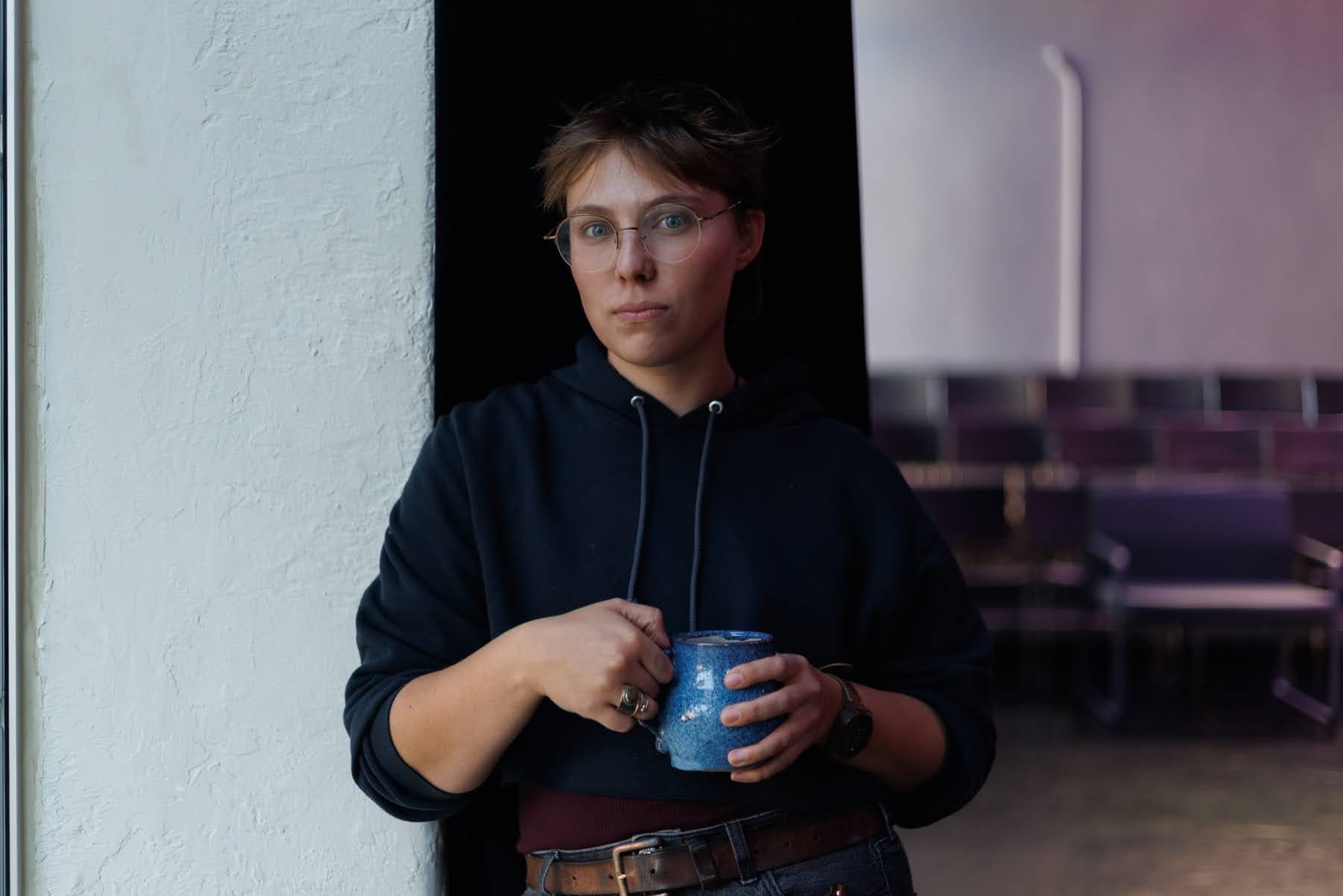
Gender Defiant is thrilled to welcome playwright Mal MacKenzie this week talking about their own transition, the grief their mother felt while it was happening, and their new play, AURA, in which a mother creates an chatbot to retain an artificial, cisgender version of her still-living child.
My medical transition happened in relative secrecy. When it became clear that my mother was struggling to accept the change in her youngest child, I chose to go it alone.
I started hormones independently, paying out of pocket so they wouldn’t show up on insurance documents. I arranged to recover from gender-affirming surgery with the help of my brother and some friends.
Back in 2020, when the pandemic sent me home from my freshman year of college, I lived with my mother again and slept in my childhood bed. When operating rooms reopened and I was given a date for top surgery, I leapt. Before I disappeared for three weeks to log 300 hours on Legend of Zelda while recovering, I decided I ought to to tell her where I was going, why I wouldn’t be home, and that I’d cover the insurance bills coming down the pike. (I was lucky to have most of the cost covered by the insurance I had through her work.)
Mourning
I pursued the surgery alone, I explained, because I knew she wouldn’t be supportive, and I didn’t want her to try and talk me out of it.
She still did, of course. She begged me to reconsider. Told me how much it hurt that I had kept this process secret. Said I would regret my long-considered choice. Then she told me:
I feel like I am mourning my child.
Hearing those words from her mouth, I knew there was no argument I could make for why she should support me. This was not a logic issue. It was emotional.
My first reaction was to judge my mother’s grief. There is a cliche within the trans community: “my parent told me they feel like I’m dead.” While I still hold that isn’t the healthiest response, I wanted to pause my judgment and explore why so many with trans loved ones feel such loss.
I’m a theatremaker by trade, so I wrote a play about it titled AURA.
Dismissive
I started writing AURA while trying to grasp why parents experience such acute grief when their child transitions. AURA is informed by my experience, but it’s not about my mother—she went on to spend years working through her emotions so that we could have a mutually respectful, loving relationship.
That work wasn’t easy for her. There aren’t many spaces where one can safely express the sense of loss that comes with a loved one’s transition. It’s a common enough situation that a quick search yields plenty of articles guiding people through this “ambiguous grief.” But alongside the articles, there are as many Reddit threads dismissing parents asking for help: “Your child is alive, be grateful.”
There aren’t many spaces where one can safely express the sense of loss that comes with a loved one’s transition.
A more ideal place to work through that grief would be a local PFLAG meeting or the privacy of therapy.
You know what really wouldn’t be ideal?
AI.
Authenticity
What would happen if a woman in my mother’s position turned to AI in her grief? That’s what happens in AURA.
Shannon, a single mom, struggles to catch up with the changes she sees in her son Dustin as he transitions from female to male. Her solution is to create a secret AI griefbot, modeled on Dustin, that feeds on data she provides to simulate a version of him that never transitioned at all.
The story in AURA isn’t a hypothetical—it’s a reality. We are increasingly outsourcing our emotional processing, health care, and even our grief onto AI agents. The problem of turning to AI for emotional support is heightened by our broken healthcare system and our reliance on social media for connection.
In his famous essay “The work of Art in the Age of Mechanical Reproduction,” philosopher Walter Benjamin writes about what sets Mona Lisa apart from a perfect forgery or mass produced print. To Benjamin, it is a sense of authenticity that comes from the artwork’s movement in space and time—the places it has been, the souls that have considered it, all the “experiences” the art has had. Benjamin calls this context the work’s “aura.”
Not coincidentally, my play’s title and the name of the fictional AI company in it is AURA. It asks: how does Benjamin’s idea apply to AI in an attempt to create a “forgery,” or “replica,” of a human being? What context of that person would be lost?
“You’re a sousaphonist”
People cannot be boiled down to data points. The belief that AI can recreate a human consciousness is scarcely different from the notion that a human can slot neatly into the categories “man” and “woman.” Both deny the context crucial to human authenticity.
If you saw me today, you might not perceive that I am transgender, or if you did, you might puzzle over what flavor of trans I am. I have experienced life as a girl, as a woman, and as a man. All of those categories left me feeling a bit limited. My personal context includes that I was raised as a girl, transitioned to a man, and then decided my gender was better expressed abstractly.
Let me explain that via an example outside of gender. In our capitalist society, many people identify with their career. When asked “tell me about yourself,” they start with “I’m a nurse.” But what happens when that nurse pursues a PhD, becomes a professor, and starts to teach?
People cannot be boiled down to data points. The belief that AI can recreate a human consciousness is scarcely different from the notion that a human can slot neatly into the categories “man” and “woman.”
Their experiences as a child, a friend, a medical student, a provider, the kind of nursing they worked in—that context is part of their life as a teacher. It would be absurd to look at their high school marching band photo and insist “you aren’t a teacher, you’re a sousaphonist.”
Shallow narratives
Writing AURA was a deeply personal process. It began with my relationship with my mother and broadened into responding to the vicious attacks on trans people right now. The play also responds to shallow media narratives that reduce nuanced trans stories to “my mom kicked me out” or “my mom accepted me.”
There is a reason AURA is a play and not a short film or a book. I am interested in assembly, in getting people into rooms with each other where strangers are encouraged to laugh at the same joke and to hear the person behind them laugh at something they don’t think is very funny at all. To generally exist for an hour or so in a collective, ephemeral darkness.
AURA is not just a chance to cast trans actors and tell a trans story. It’s a message for all of us about the dangers of turning to AI for solace when other humans are complicated and cruel.
The recommended course of action when someone you love is experiencing AI psychosis is to persuade them to log off and to encourage real human interaction. AURA is me reaching out my real, living hand.
— M.M.
Mal MacKenzie is a playwright, actor, and educator. AURA is currently a play in development. For updates on future performances or to get in touch, go to malmackenzie.com.
This essay originally appeared, in a slightly different version, in PublicSource.
Every Gender Defiant story is a crack in the wall of propaganda and hate. Consider a paid subscription to help us cover expenses as we bring you real stories of real trans lives every week.